
Nifty & Bank Nifty Open Interest: How to Read Futures OI and Price Together
A rising index is not always a strong index. Open interest tells you whether new money is pushing the move or old positions are just being closed. Here is the simple four-box rule, and the traps around expiry.
What open interest is
Open interest (OI) is the number of futures contracts that are still open at the end of the day. When a new buyer and a new seller open a position, OI goes up by one. When both close, it goes down by one. If one trader simply hands a position to another, OI does not change.
Volume tells you how busy the day was; open interest tells you whether positions were added or removed. That is what makes it useful for judging the quality of a move in Nifty, Bank Nifty and the other NSE index futures.
The four price + OI combinations
| Price | Open interest | Signal in ICC Terminal | Meaning |
|---|---|---|---|
| ⬆️ up | ⬆️ up | Strong Bullish (New Buying) | Fresh longs — the rise has new money behind it (often called long buildup). |
| ⬆️ up | ⬇️ down | Weak Rally (Short Covering) | Shorts closing — the rise lacks new buyers. |
| ⬇️ down | ⬆️ up | Strong Bearish (New Shorting) | Fresh shorts — the fall has new sellers behind it. |
| ⬇️ down | ⬇️ down | Weak Drop (Long Liquidation) | Longs closing — the fall lacks new sellers. |
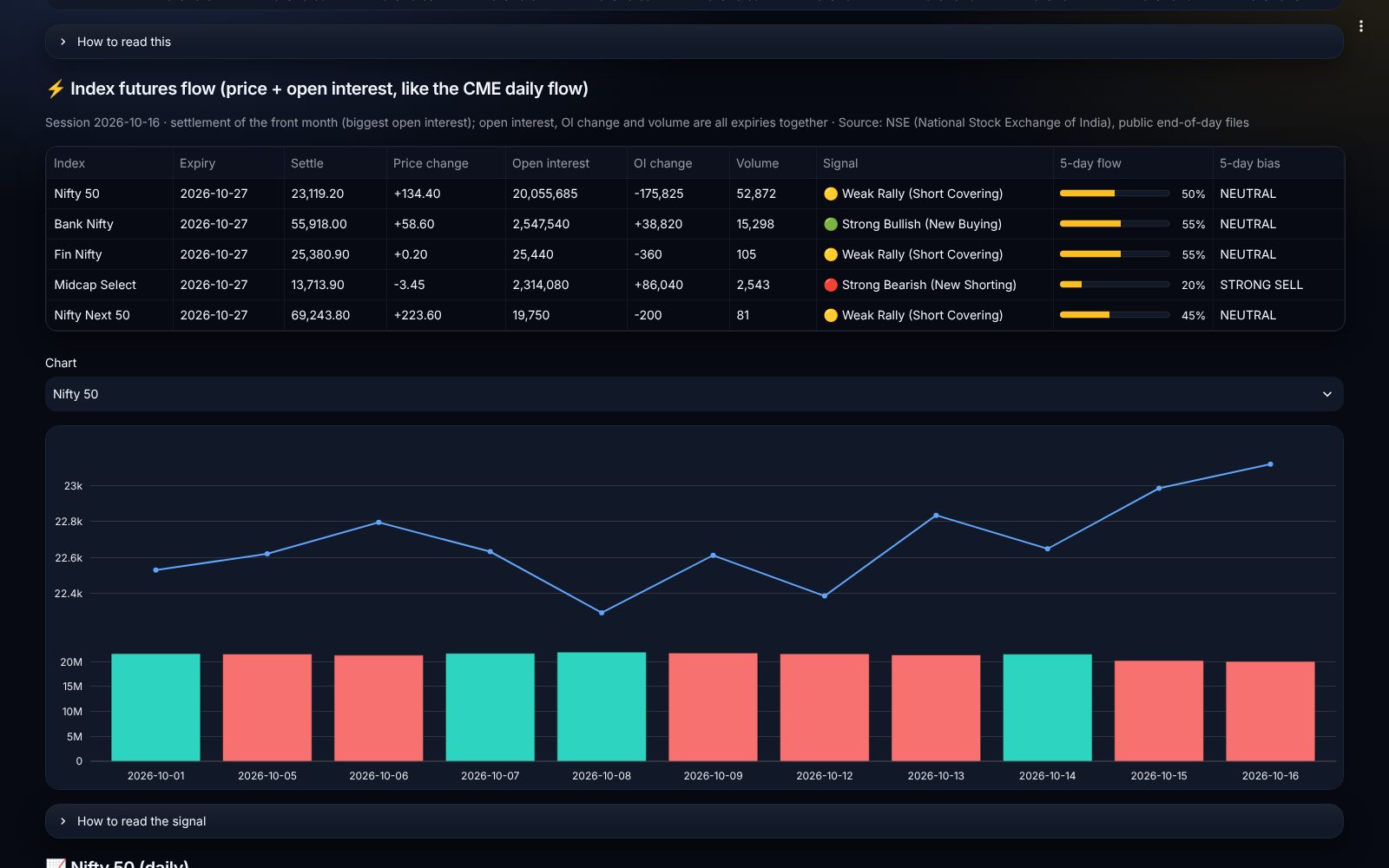
A real example from the NSE bhavcopy of 16 Oct 2026: the Nifty October future settled at 23,119.20, up 134.40, while open interest across all expiries fell by 175,825 contracts — Weak Rally (Short Covering). Bank Nifty rose 58.60 with OI up 38,820 — Strong Bullish (New Buying). Midcap Select slipped 3.45 with OI up 86,040 — Strong Bearish (New Shorting). Same day, three very different stories.
Front month, all expiries and rollover
Each index has several contracts with different expiries. Near expiry, traders close the current month and open the next one. If you only watch the expiring contract, its OI collapses and it looks like everyone is leaving — when they are simply moving to the next month.
- ICC Terminal takes the price from the front month: the contract with the biggest open interest (the same rule it uses for CME futures).
- It adds open interest, OI change and volume across all expiries, so a rollover does not fake a liquidation signal.
- On 16 Oct 2026 the October Nifty contract alone lost 348,725 contracts of OI, but November and December gained 172,900 — the net change of −175,825 is what counts.
The 5-day flow
One session can be noise. The 5-day flow scores the last five sessions: New Buying +1, Short Covering +½, Long Liquidation −½, New Shorting −1, then maps the average to 0–100%.
| 5-day flow | Bias |
|---|---|
| 75% or more | STRONG BUY |
| 60–75% | BUY |
| 40–60% | NEUTRAL |
| 25–40% | SELL |
| 25% or less | STRONG SELL |
It is the same scoring ICC Terminal uses for the CME daily flow of gold, oil and forex, so a trader who follows both markets reads them the same way.
Why Bank Nifty and Nifty can disagree
Bank Nifty is a narrower index, dominated by a handful of large banks, so it often moves earlier and harder than Nifty. When Nifty shows Short Covering but Bank Nifty shows New Buying, as on 16 Oct 2026, the fresh money is going into banks while the broader index is mostly seeing shorts close. Traders who compare the rows side by side get a quick sense of where conviction sits.
Smaller contracts such as Fin Nifty and Nifty Next 50 trade far fewer lots, so a single large order can flip their signal. Give more weight to the signals of the liquid contracts and treat the thin ones as confirmation, not as the main story.
Adding India VIX
India VIX measures the volatility traders expect in Nifty over the next month. A jump in VIX together with New Shorting in Nifty points to fear-driven selling; a falling VIX during New Buying is a calmer, steadier advance. When VIX spikes, many traders simply cut position size.
A simple evening routine
- After 7:30 PM India time, open India Markets.
- Read the Nifty and Bank Nifty Signal: new money or positions closing?
- Check the 5-day flow for the bigger direction.
- Compare with the FII net position and its change.
- Glance at India VIX, then plan the next day with your own levels and stop-loss.
Nifty futures flow, free every evening
India Markets reads the NSE F&O bhavcopy for Nifty 50, Bank Nifty, Fin Nifty, Midcap Select and Nifty Next 50, with the signal and 5-day flow for each — free for everyone. Source: NSE.
FAQ
Why does open interest drop sharply near expiry?
Traders close or roll the expiring contract into the next month. That is why ICC Terminal adds the open interest of all expiries together: a rollover does not look like traders leaving.
Which index futures does ICC Terminal track?
Nifty 50, Bank Nifty, Fin Nifty, Midcap Select and Nifty Next 50 futures, from the NSE F&O bhavcopy, every trading day.
Is open interest a buy or sell signal?
No. It shows whether a move is backed by new positions or by positions closing. Use it to judge the strength of a move, together with your own levels and risk rules.