
FII / DII Data Explained: How to Read NSE Participant-wise Open Interest
Every evening NSE tells you how many Nifty and Bank Nifty futures foreign institutions, Indian institutions, pros and retail clients hold long and short. Here is how to read those numbers without getting fooled by them.
What participant-wise open interest is
After every trading day the National Stock Exchange of India (NSE) publishes a small public file called participant-wise open interest. It counts every open derivatives contract — index futures, stock futures, index options and stock options — and splits it between four groups of traders. It is India's daily cousin of the US CFTC COT report, with one big advantage: it comes out every day, not once a week.
Most traders focus on one part of the file: index futures, because Nifty and Bank Nifty futures are where large players take direct, leveraged bets on the whole market.
FII, DII, Pro and Client
| Group | Who they are | What to expect |
|---|---|---|
| FII (foreign institutions) | Foreign banks, funds and portfolio investors (FPIs) | The most watched group; large and fast-moving. |
| DII (domestic institutions) | Indian mutual funds, insurers, banks | Often hold futures as hedges against big share portfolios. |
| Pro (proprietary) | Brokers trading their own money | Active, short-term, often market-neutral. |
| Client | Retail traders and other broker clients | Frequently on the other side of FIIs. |
Because every futures contract has a buyer and a seller, the four groups always balance out: total long equals total short, and the four net positions add up to zero. If FIIs are heavily short, someone — often clients — is equally long.
Long, short, net and net change
- Long — contracts that gain when the index rises.
- Short — contracts that gain when the index falls.
- Net = Long − Short. Positive means net long, negative means net short.
- Net change — how much the net moved since the previous session. This is often more useful than the net itself.
- Long % — the share of a group's position that is long. 50% is balanced; 11% means almost everything is short.
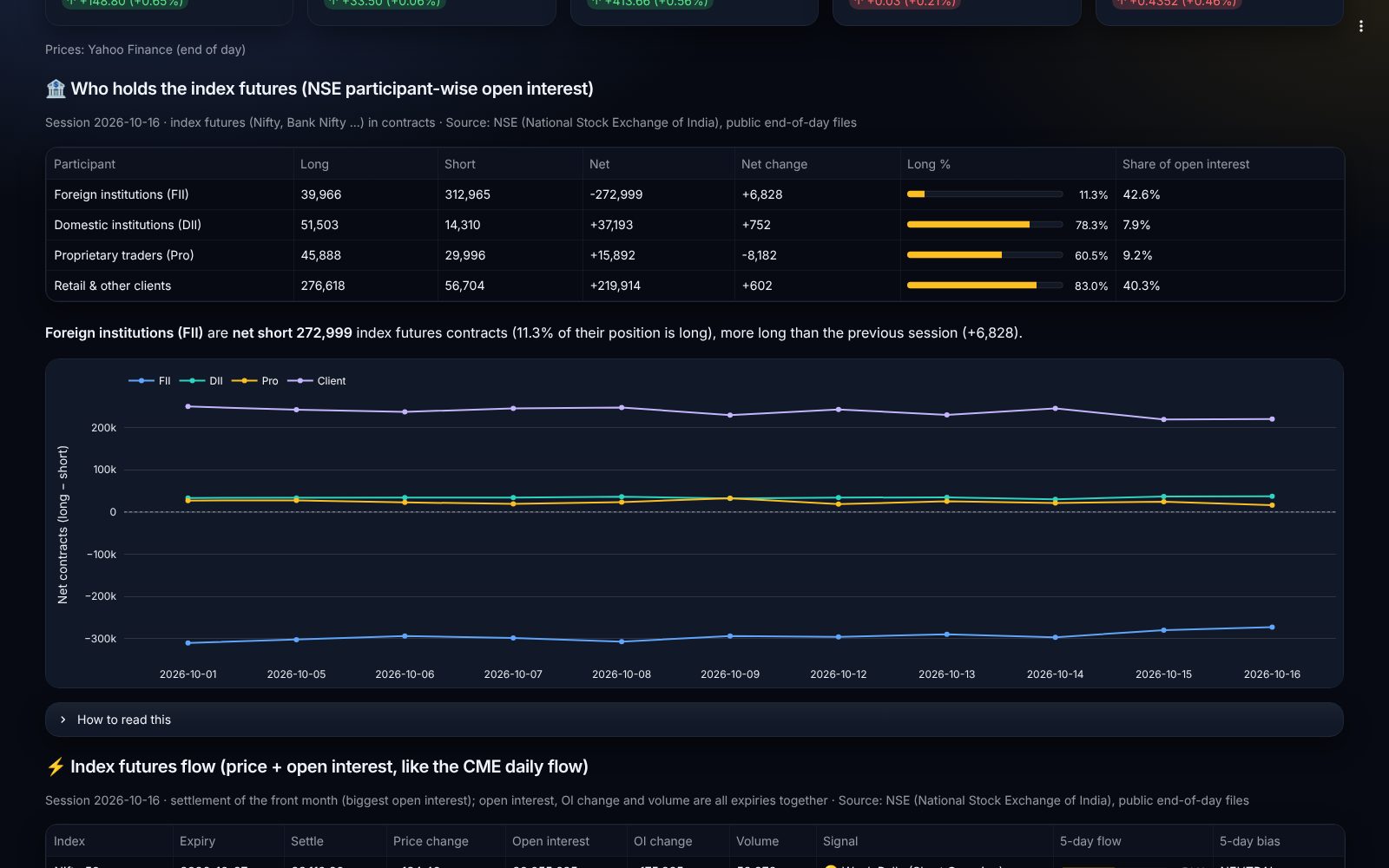
Example from the 16 Oct 2026 file: FIIs held 39,966 index futures long and 312,965 short — a net short of 272,999 contracts, with only 11.3% of their position long. The day before the net short was 279,827, so the net change was +6,828: still very short, but a little less so.
How to read the FII position
| What you see | What it usually means |
|---|---|
| FII net short and getting shorter for several days | Foreigners adding shorts or hedges — caution for longs. |
| FII net short but net change positive day after day | Short covering — selling pressure easing; often seen before rallies. |
| FII long % rising over a week | Foreign money turning more bullish. |
| FII net long and rising | Strong foreign buying in index futures. |
| Clients very long while FIIs very short | Retail on the other side of institutions; many traders read it as a contrarian warning. |
The direction over 5–20 sessions matters more than any single day. That is why ICC Terminal draws a Net position trend chart for all four groups: one glance shows whether the FII line is climbing (covering) or falling (adding shorts).
The hedging trap
FIIs own a large share of Indian equities. When they want protection, the cheapest tool is to sell Nifty futures. A big FII short can therefore be insurance on shares, not a bet that the market will crash. DIIs do the same with their portfolios.
Where to see it in ICC Terminal
- Website: iccterminal.trade/india — no login needed.
- Web terminal / Windows app: the 🇮🇳 India Markets button above the tabs.
- Android app: the 🇮🇳 India Markets tile in the REGIONAL MARKETS · FREE section of the Home screen.
NSE publishes in the Indian evening; ICC Terminal fetches the file from about 14:00 UTC (7:30 PM India time) and retries until the session is in. Weekends and NSE holidays have no new file. The full walk-through is in the India Markets guide (English and Hindi).
FII / DII positions, free every evening
India Markets shows the participant-wise open interest, the Nifty and Bank Nifty futures flow, Nifty, Sensex, India VIX and USD/INR — free for everyone. Source: NSE.
FAQ
When does NSE publish the participant-wise open interest?
Every trading day in the Indian evening, after the market closes. ICC Terminal downloads it from about 14:00 UTC (7:30 PM India time).
Does a big FII short mean the market will fall?
Not always. Many FII index futures shorts are hedges against the Indian shares they own. The trend of the FII net position and its daily change say more than one day's number.
Is the FII / DII data free on ICC Terminal?
Yes. India Markets is free for everyone on the website, the web terminal and the Android app, with or without an account.