
USD/PKR Rate: What Moves the Dollar to Rupee Exchange Rate
The dollar rate touches everything in Pakistan — petrol, phones, imported medicine, school fees abroad and PMEX gold. Here are the forces that push USD/PKR up and down, explained without jargon and without predictions.
How to read USD/PKR
USD/PKR is the number of Pakistani rupees needed to buy one US dollar. When it rises, the rupee is getting weaker; when it falls, the rupee is getting stronger. On 16 Oct 2026 the daily reference rate was about 276.86.
Like any price, it is set by supply and demand for dollars inside Pakistan. Dollars come in from exports, remittances, loans and investment; they go out for imports, debt repayments and profits sent abroad. Everything below is a way that balance shifts.
Interbank vs open market rate
| Rate | Who uses it | What it tells you |
|---|---|---|
| Interbank | Banks trading dollars with each other for imports, exports and large payments | The main market rate; it drives import costs. |
| Open market | Exchange companies selling and buying cash dollars | The rate you pay at the counter for travel or cash. |
The two are normally close. A wide gap between them usually means dollars are scarce or controlled, and the State Bank of Pakistan (SBP) often takes steps to close it. Watching that gap is one of the simplest stress indicators for the rupee.
The five big forces
1. SBP reserves and interest rates
The State Bank of Pakistan holds the country's foreign exchange reserves. When reserves are strong — covering several months of imports — markets are calmer. When they fall, people fear the bank cannot meet dollar demand and the rupee weakens. The SBP policy rate matters too: higher rupee interest rates make holding rupees more attractive and can support the currency, while big cuts can weaken it if inflation is still high.
2. IMF programmes and external financing
Pakistan has relied on IMF programmes many times. A new programme, or the release of a tranche after a review, usually unlocks other loans and calms the market. Delays or failed reviews do the opposite. Loans and rollovers from friendly countries and multilateral lenders play a similar role.
3. The current account
The current account is, roughly, exports plus remittances minus imports and income paid abroad. A deficit means more dollars leave than arrive and must be financed by borrowing or reserves. A surplus or a small deficit is supportive for the rupee.
4. Remittances
Money sent home by Pakistanis working abroad is one of the country's largest sources of dollars. Strong monthly remittance numbers — often higher before Ramadan and Eid — help the rupee. When the official rate is far from the open market, more money flows through informal channels instead, and official dollar supply drops.
5. The oil bill and global prices
Pakistan imports most of its oil and a lot of its gas. When international crude rises, the import bill grows and dollar demand rises with it. That is why a trader watching USD/PKR also watches crude oil — a market ICC Terminal tracks with COT and CME data.
Reading the news through these forces
- Reserves up, IMF tranche received → usually supportive for the rupee.
- Oil spikes, big import bill → more dollar demand, pressure on the rupee.
- Record remittances → more dollar supply, supportive.
- Wide interbank / open market gap → stress; watch what the SBP does next.
- Global dollar strength → many emerging-market currencies weaken together.
Following USD/PKR on ICC Terminal
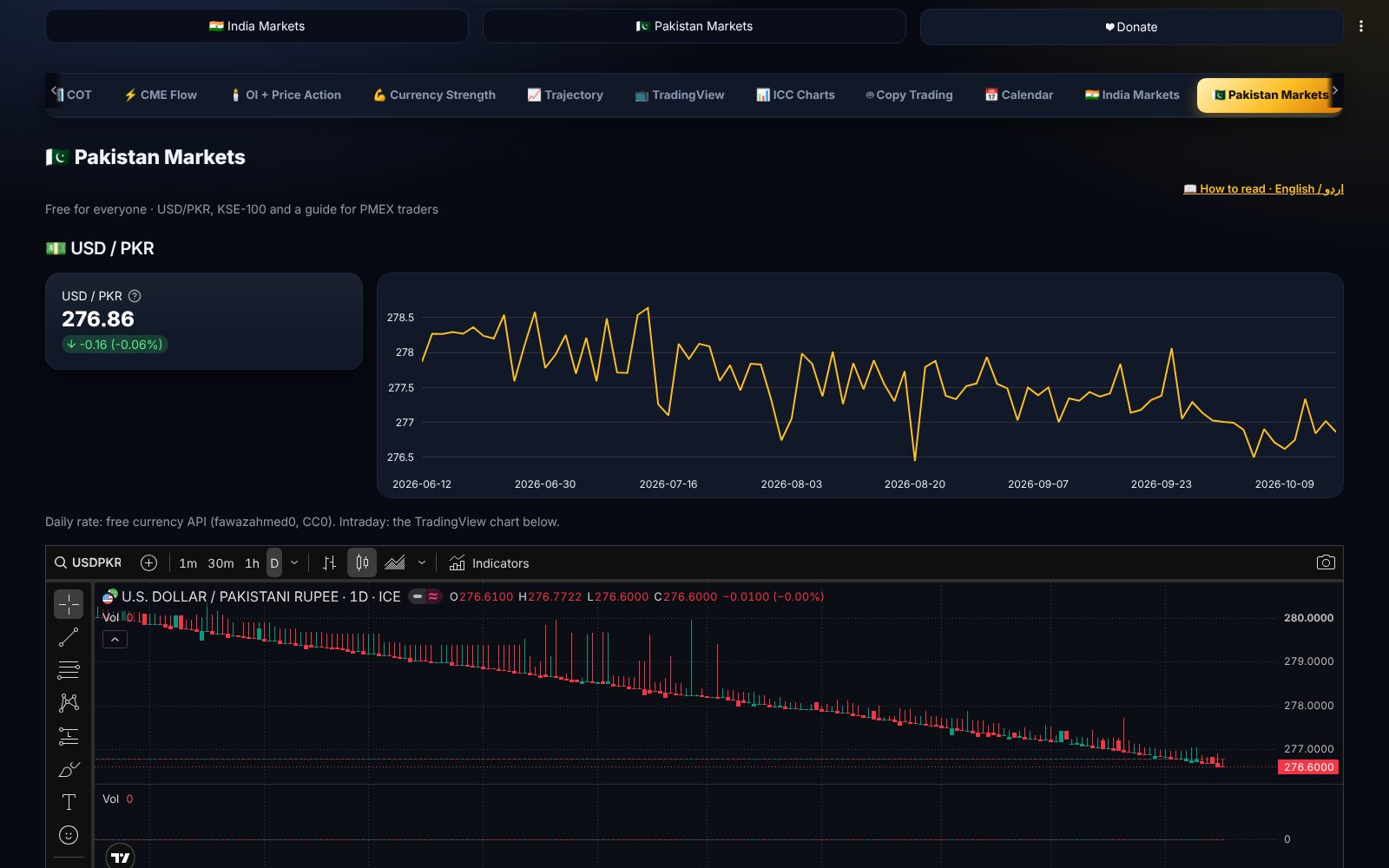
- Daily reference rate and change, with a 90-day chart, from a free currency data service (shown red when the rupee weakens).
- A live TradingView chart (FX_IDC:USDPKR) for intraday moves.
- The PMEX traders map on the same page, because PMEX gold and oil are priced in rupees.
Open it at iccterminal.trade/pakistan, with the 🇵🇰 Pakistan Markets button in the web terminal or the tile on the app's Home screen. Your bank's or exchange company's rate can differ a little from the reference rate.
USD/PKR, KSE-100 and PMEX in one place
Pakistan Markets shows the dollar rate, its chart, KSE-100 links and which ICC market each PMEX contract follows — free for everyone.
FAQ
What is the difference between the interbank and the open market dollar rate?
The interbank rate is the rate at which banks trade dollars with each other for trade and large payments. The open market rate is what exchange companies charge for cash dollars. They are usually close; a wide gap is a sign of stress in dollar supply.
Why does ICC Terminal show a rising USD/PKR in red?
A rising USD/PKR means the rupee is getting weaker: you need more rupees for one dollar. For most Pakistani users that is the bad direction, so it is shown in red.
Can anyone predict the dollar rate?
No one can reliably predict it. Knowing what moves the rate helps you understand the news; it does not tell you tomorrow's rate.