
Forex COT Report: Reading Positioning for the Major Pairs
Forex has no central exchange, but currency futures trade on CME and appear in the CFTC report every week. Read them right — including the inverted pairs that confuse many traders — and you get a weekly map of where funds stand on the dollar.
Why forex traders use futures data
Spot forex is traded over the counter between banks and brokers, so there is no public record of who holds what. Currency futures on CME Group are different: large positions must be reported, and the CFTC publishes them every Friday at 3:30 PM New York time, showing positions as of Tuesday.
Because the futures and spot prices move together, the positioning of hedge funds and asset managers in futures is a useful proxy for how the big money views each currency.
How currency futures are quoted
Every CME currency future is priced as US dollars per unit of the other currency. That matches some pairs and is the reverse of others:
| Pair | Future | Same direction as the pair? |
|---|---|---|
| EURUSD, GBPUSD, AUDUSD, NZDUSD | Euro, pound, Aussie, kiwi futures | ✅ Yes — long the future = long the pair |
| USDJPY | Japanese yen future | ❌ Inverted — long yen = short USDJPY |
| USDCAD | Canadian dollar future | ❌ Inverted |
| USDCHF | Swiss franc future | ❌ Inverted |
| USDMXN, USDZAR, USDBRL | Peso, rand, real futures | ❌ Inverted |
| EURGBP, EURJPY | Euro/pound and euro/yen cross futures | ✅ Yes — quoted like the pair |
So if funds are heavily long the yen future, they are betting on a falling USDJPY. Forgetting this is the most common COT mistake in forex.
Reading the major pairs
EURUSD
The euro future is one of the largest currency contracts. A rising speculator net long and a COT index above 70% show funds building euro exposure against the dollar. Watch the weekly change: steady additions over several weeks matter more than one big week.
GBPUSD
The pound often swings between extremes, so the COT index is useful to spot crowded positioning before big UK news.
USDJPY
Funds frequently hold large yen shorts when interest-rate differences favour the dollar. When those shorts start to shrink — the yen net position rising from deep negative levels — USDJPY can fall quickly as positions unwind.
AUDUSD and NZDUSD
These are risk-sensitive currencies. Speculators adding longs in both often line up with a positive risk mood; heavy shorts with a defensive one.
Building a dollar picture
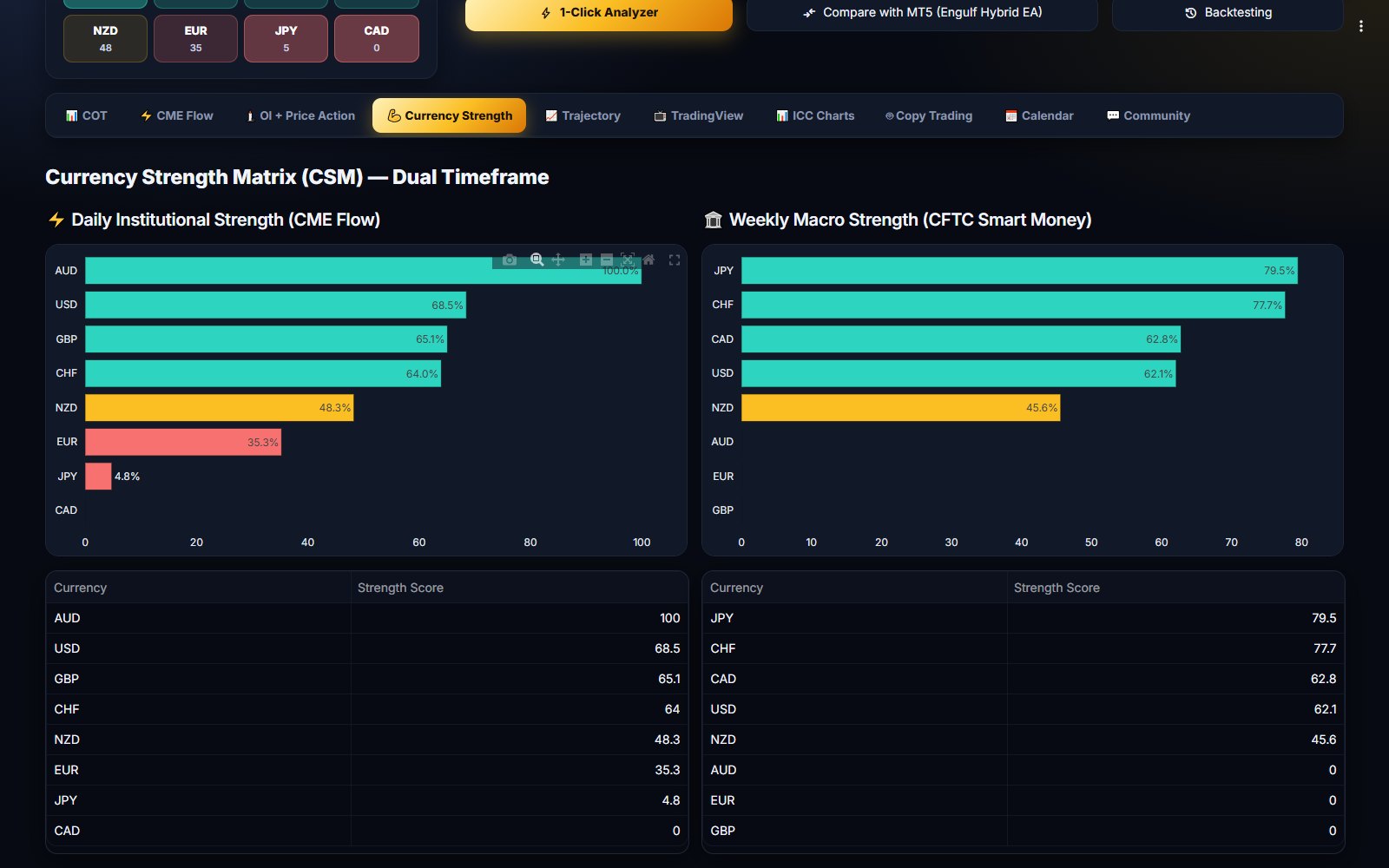
There is no single “dollar future” in the report that covers everything, but you can build a picture from the seven majors. ICC Terminal does this in its weekly currency strength view: the euro, pound, Aussie and kiwi take their COT index directly, while the yen, Canadian dollar and Swiss franc take 100% minus the pair's index. The dollar's score is the average of the dollar side of all seven pairs.
A strong-currency-versus-weak-currency pairing is often a cleaner idea than a pair where both sides are neutral. Read more in the currency strength meter guide.
A weekly routine for forex traders
- After Friday's release, open the COT tab and filter forex.
- Note pairs with a STRONG BUY or STRONG SELL weekly bias and check the monthly COT for agreement.
- Check the currency strength ranking for the strongest and weakest currency.
- During the week, use the CME daily flow (price and open interest) to see whether new money confirms the weekly direction.
- Plan entries with your own levels and a stop-loss.
Crosses and emerging-market pairs
EURGBP and EURJPY have their own CME cross futures, quoted as euros in pounds and euros in yen — the same way as the pairs, so no inversion is needed. Their COT data is thinner: in some weeks too few large traders hold them for the CFTC to report, so gaps are normal.
USDMXN, USDZAR and USDBRL come from the peso, rand and real futures, which are quoted in dollars per unit and therefore inverted like the yen. These currencies are popular carry trades: speculators often hold large longs in the emerging currency (short the USD pair) while interest rates are high, and those positions can unwind quickly in a risk-off week.
For every pair, the useful questions are the same: is the net position rising or falling, is the COT index near an extreme, and does the daily CME flow confirm the weekly picture?
Forex COT, already inverted for you
ICC Terminal covers 12 currency pairs (seven majors plus EURGBP, EURJPY, USDMXN, USDZAR and USDBRL) with weekly and monthly COT, CME daily flow and currency strength. See the guide.
FAQ
Why is the yen future the opposite of USDJPY?
CME quotes the yen future in US dollars per yen. When the yen gets stronger the future rises while USDJPY falls, so a long yen future equals a short USDJPY.
Does the COT report include spot forex positions?
No. It only covers futures and options on regulated US exchanges. Futures positioning is used as a proxy for how large traders view each currency.
Which currency pairs does ICC Terminal cover?
EURUSD, GBPUSD, USDJPY, USDCAD, USDCHF, AUDUSD, NZDUSD, EURGBP, EURJPY, USDMXN, USDZAR and USDBRL, each read in the pair's own direction.