
Smart Money vs Hedgers: Who Is Who in the COT Report
The COT report splits the market into groups with very different reasons to trade. Knowing who is who — and why they usually stand on opposite sides — is the key to reading positioning correctly.
The three groups
In the legacy Commitments of Traders report, every reportable position belongs to one of two groups, and everything below the reporting size is lumped into a third:
| Group | Typical members | Main goal |
|---|---|---|
| Non-commercials (large speculators) | Hedge funds, CTAs, commodity pools, money managers | Profit from price moves |
| Commercials (hedgers) | Producers, processors, exporters, airlines, banks and dealers hedging business risk | Protect against adverse price moves |
| Non-reportables (small traders) | Traders below the CFTC reporting thresholds | Mostly speculation |
Why speculators are called smart money
Large speculators are professional, well funded and usually trend following. They tend to buy as prices rise and sell as prices fall, and their combined positions are big enough to move markets. When they keep adding to a net long week after week, the trend usually has support.
“Smart” does not mean always right. Speculators are often most heavily positioned near the end of a trend, because that is when the trend has been running longest. That is why the COT index is so useful: it shows when their positioning reaches an extreme.
Why hedgers trade against the trend
Commercials are not trying to win on price. A gold miner sells future production when prices are high to lock in profit; a jewellery maker buys when prices are low to secure supply. An airline buys oil futures to fix its fuel cost; an oil producer sells them.
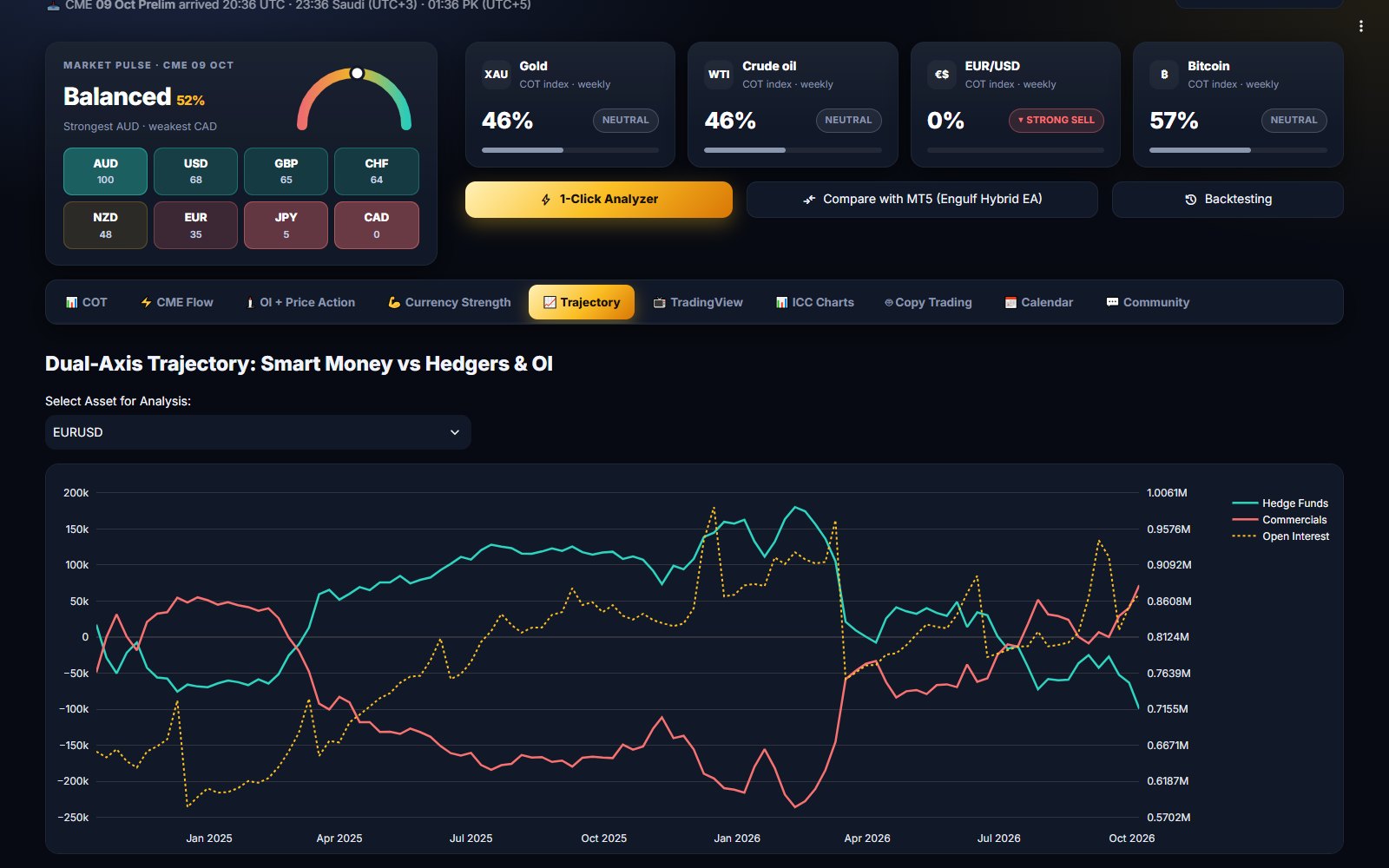
The result is that hedgers usually sell into rallies and buy into declines. Their net position moves almost as the mirror image of the speculators': when funds are very long, commercials are very short. Some traders read extreme commercial positions as value signals — hedgers buying heavily at multi-month lows can mark a floor — but commercial positions are mainly a response to price, not a forecast.
What small traders tell you
Non-reportable positions are the smallest group. Some traders watch them as a contrarian signal: when small traders are heavily long while large speculators are reducing, the crowd may be late. Treat it as background information rather than a signal on its own.
How ICC Terminal shows the groups
- The COT tab shows the smart money net (non-commercials) and the hedgers net (commercials) for every market, with the COT index built from the speculators' net position.
- The Trajectory chart draws both lines over about two years with open interest, so you can see them move in opposite directions and spot when the gap is unusually wide.
- For USDJPY, USDCAD, USDCHF and the other inverted pairs, both lines are turned around so they read in the pair's direction.
How to use both groups
- Follow speculators for direction. A rising speculator net position with rising open interest supports the trend.
- Watch hedgers for stretched conditions. When commercials hold an unusually large net long, prices are low enough that real buyers are stepping in.
- Look for agreement. The strongest setups come when speculators start turning from an extreme while hedgers are at their own extreme on the other side.
- Time with daily data. Confirm with the CME price and open interest flow before acting.
Examples by market
Gold
In gold, the commercials include miners, refiners and bullion dealers. Their net position is almost always short, because producers hedge future output. It becomes less short when prices fall, as hedging slows and dealers buy. Speculators drive most of the swings. See the gold COT report guide.
Crude oil
Oil producers sell futures into rallies while refiners and airlines buy on dips, so commercial positions swing with price. Read more in the crude oil COT guide.
Currencies
In currency futures the commercial side is mostly banks and dealers balancing their books, plus companies hedging foreign income. Speculator positioning is usually the more informative line, which is why forex traders focus on it.
Stock indices
In S&P 500 or Nasdaq futures, commercials include dealers and asset managers hedging share portfolios. Their net short often grows when markets rise simply because portfolios grow, so compare positions with their own history.
Common mistakes
- Calling commercials “smart money”. Some articles do, because hedgers know their own business well. But their futures positions are driven by hedging needs, so they trade against price by design.
- Reading one week in isolation. Positions shift with contract rolls and one-off hedges. Look at several weeks and the COT index.
- Ignoring market size. A change of 10,000 contracts is large in palladium and small in the S&P 500. Compare with open interest.
- Expecting precise timing. The report is weekly and published three days after the data date.
Smart money and hedgers side by side
ICC Terminal shows both groups for 42 futures markets, every week, with charts going back years. The guide explains the Trajectory chart.
FAQ
Who are commercials in the COT report?
Traders who use futures to hedge a business risk, such as producers, processors, exporters, airlines and dealers. They are classified as commercial by the CFTC.
Should I follow commercials or speculators?
Most traders follow large speculators for the trend and watch commercials for stretched conditions. Hedgers usually trade against price moves by design.
Why do commercials and speculators mirror each other?
Every contract has a buyer and a seller. When speculators buy a rising market, hedgers are often the ones selling to them to lock in prices.