
Copper COT Report: Reading the “Dr. Copper” Signal
Copper is used in buildings, cables, cars and power grids, so traders watch it as a quiet read on the world economy. This guide shows how to read the weekly COT data for copper in plain steps.
Why copper is called Dr. Copper
Copper goes into wiring, pipes, motors, electric vehicles and power grids. When factories and builders order more, copper demand tends to rise; when the economy slows, demand often cools. Because of this link, traders half-jokingly call it Dr. Copper, as if it had a degree in economics. It is a habit of the market, not a law: copper also reacts to mine supply, warehouse stocks and news from large buyers.
The futures that feed the weekly Commitments of Traders report trade on COMEX, part of CME Group. ICC Terminal follows them as HG_COPPER in the COT tab, beside gold, silver and oil.
Who holds copper futures
- Non-commercials (large speculators): funds and trading firms that take a view on direction. Their net position is the sentiment reading.
- Commercials: miners, smelters, cable makers and dealers that hedge real copper. Producers tend to sell futures to fix a price; users tend to buy.
- Small traders: the rest, usually a noisy group.
Remember that the commercial side is a hedge, not a forecast. Our guide to smart money vs hedgers explains why the two big groups often sit on opposite sides.
How to read the copper report
- Look at the speculator net position over several weeks. Is it rising, falling or flat? The direction of change says more than one number.
- Place it in its range with the COT index. The COT index shows where today's net position sits between its recent low and high. In ICC Terminal, 70% or more on the 13-week view reads STRONG BUY and 30% or less STRONG SELL. An extreme reading means a crowded trade, not a guaranteed turn.
- Compare with price. If copper makes a new high while speculators stop adding longs, the move may be running out of support.
- Check open interest. Price up with open interest up suggests new money is joining. See open interest and price action for all four combinations.
Copper next to gold and silver
Open the copper COT beside the gold COT and the silver COT. The three metals tell different stories:
- Gold rising with copper flat: investors may be buying safety while growth hopes stay weak.
- Copper positioning rising while gold positioning falls: the market may be leaning towards growth rather than fear.
- All three rising together: broad appetite for metals, often with a weak dollar in the background.
The copper-to-gold price ratio is another common reference. A rising ratio is often read as growth optimism, a falling ratio as caution. Treat it as context, never as a signal on its own.
A simple weekly routine for copper
Here is a short routine you can repeat every Friday after the report is out. It takes about ten minutes and keeps you from reacting to a single week.
- Open the copper chart in the COT tab and note the direction of the speculator net position over the last four to eight weeks.
- Write down the COT index zone: low, middle or high. Do not trade the zone itself; use it to know whether the crowd is already leaning one way.
- Look at price on a daily chart. Does it agree with the positioning or fight it? Disagreement is a reason to be careful, not a reason to enter.
- Check the dollar and the metals next to copper, then decide whether you need a trade at all. Doing nothing is a valid result.
Keep short notes. After a few months you will see how copper behaved in each zone for your own style, which is worth more than any rule written here.
Common mistakes
- Reading China news into the data. The COT report only shows who holds COMEX contracts, not why they do.
- Treating the weekly report as a timer. It reflects Tuesday positions and is published on Friday; use it for background direction.
- Ignoring contract rollover. Open interest and volume can shift around delivery months without a change of opinion.
- Forgetting the dollar. A strong dollar often weighs on metals, so check the currency strength meter.
How to use it with other ICC tools
Use the COT tab for the weekly background, then the daily CME volume and open interest to see whether money is arriving now. The COT guide describes each chart and column, and the free COT course teaches the basics step by step. Unsure of a term? Look it up in the COT glossary.
Before you trade a metal, check what a move is worth with the free lot size calculator and pip value calculator on ICC Charts.
Copper positioning in one place
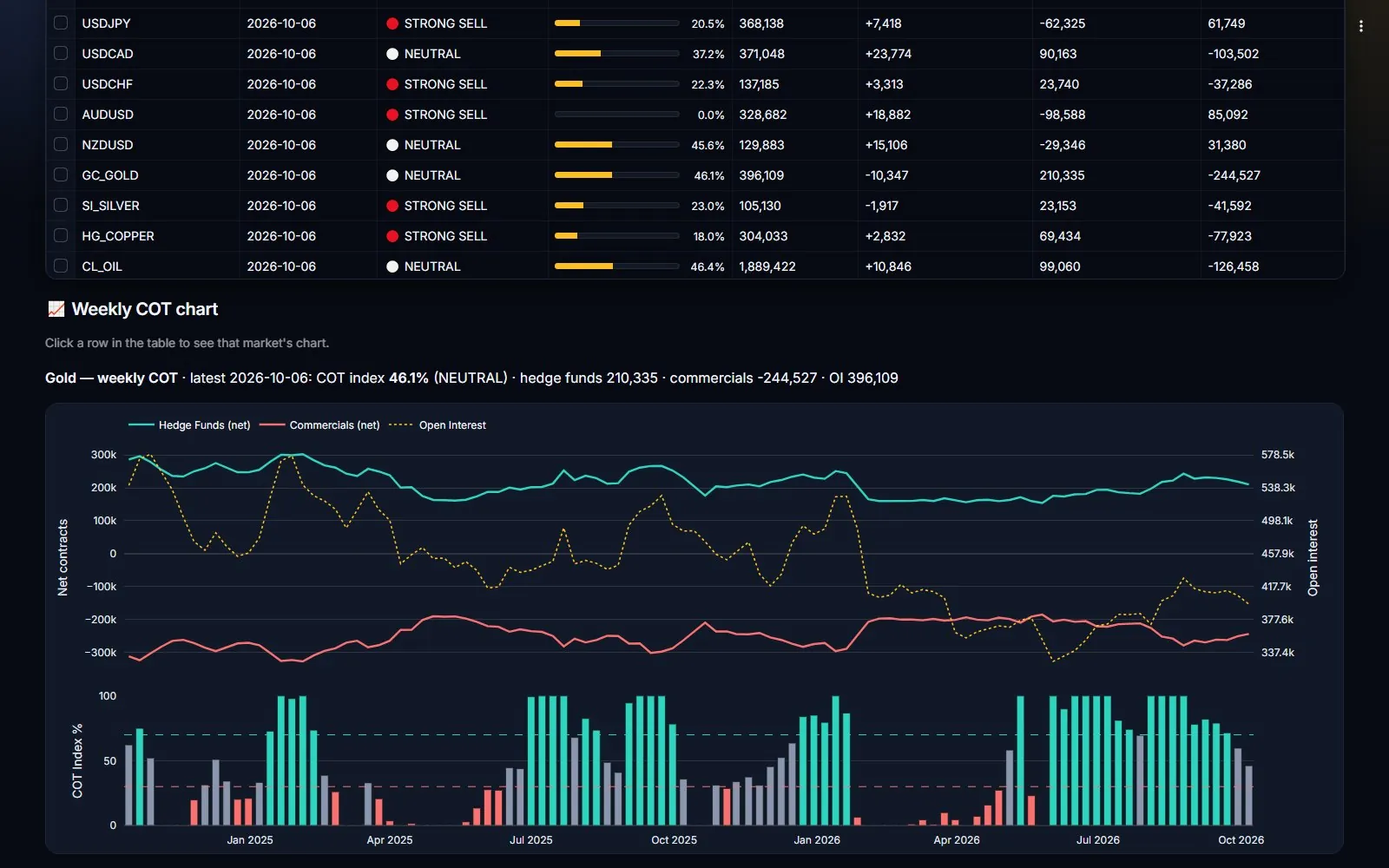
The COT tab in ICC Terminal includes copper, gold, silver, oil, indices, currencies and more.
FAQ
Why is copper called Dr. Copper?
Because copper demand follows construction, manufacturing and power projects, traders treat its price as a rough health check of the economy. The nickname is a market habit, not a rule.
Which copper market does ICC Terminal track?
COMEX copper futures, shown as HG_COPPER in the COT tab.
Is copper COT the same as gold COT?
The report format is the same, but the drivers differ. Gold reacts mostly to fear, rates and the dollar; copper reacts more to industry and growth news.