
Japanese Yen COT Report: Reading USDJPY Positioning
USDJPY is quoted against the dollar, but the COT report tracks the yen future itself. This guide explains the inversion, the carry trade and how to use yen positioning as a background filter.
Why the yen COT matters
The Japanese yen is one of the most watched currencies in the world. It is often the funding currency for global trades and it tends to move when investors suddenly change their appetite for risk. Spot forex has no central exchange, so there is no official position report for USDJPY. The nearest public source is the CME Japanese yen futures, which are regulated by the CFTC and listed in the weekly COT report.
This guide explains what that data measures, how it connects to the USDJPY chart you trade, and how to avoid the most common reading mistakes.
What the CME yen future is
The CME yen contract is a futures contract on the yen itself, priced in US dollars per yen. It is a separate market from the spot pair, but the two are linked by arbitrage, so large moves in one are normally seen in the other. In the COT report you will see two groups that matter most for currencies:
- Speculators (non-commercials) — hedge funds and large trading firms taking a view. Their net position (longs minus shorts) is the main sentiment reading.
- Hedgers (commercials) — banks and companies that manage currency risk from real business, such as exporters. Their position often moves against the speculators.
The smart money vs hedgers guide explains how to treat each group, and the managed money vs commercials guide explains the different report types.
The inversion: yen up means USDJPY down
This is the part beginners most often get wrong. USDJPY is quoted as dollars against yen, but the CME future is on the yen alone. Buying the yen future is the same view as selling USDJPY, because you expect the yen to strengthen against the dollar.
- Speculators adding yen longs = they expect a stronger yen = a bearish view on USDJPY.
- Speculators holding a large yen net short = they expect a weaker yen = a bullish view on USDJPY.
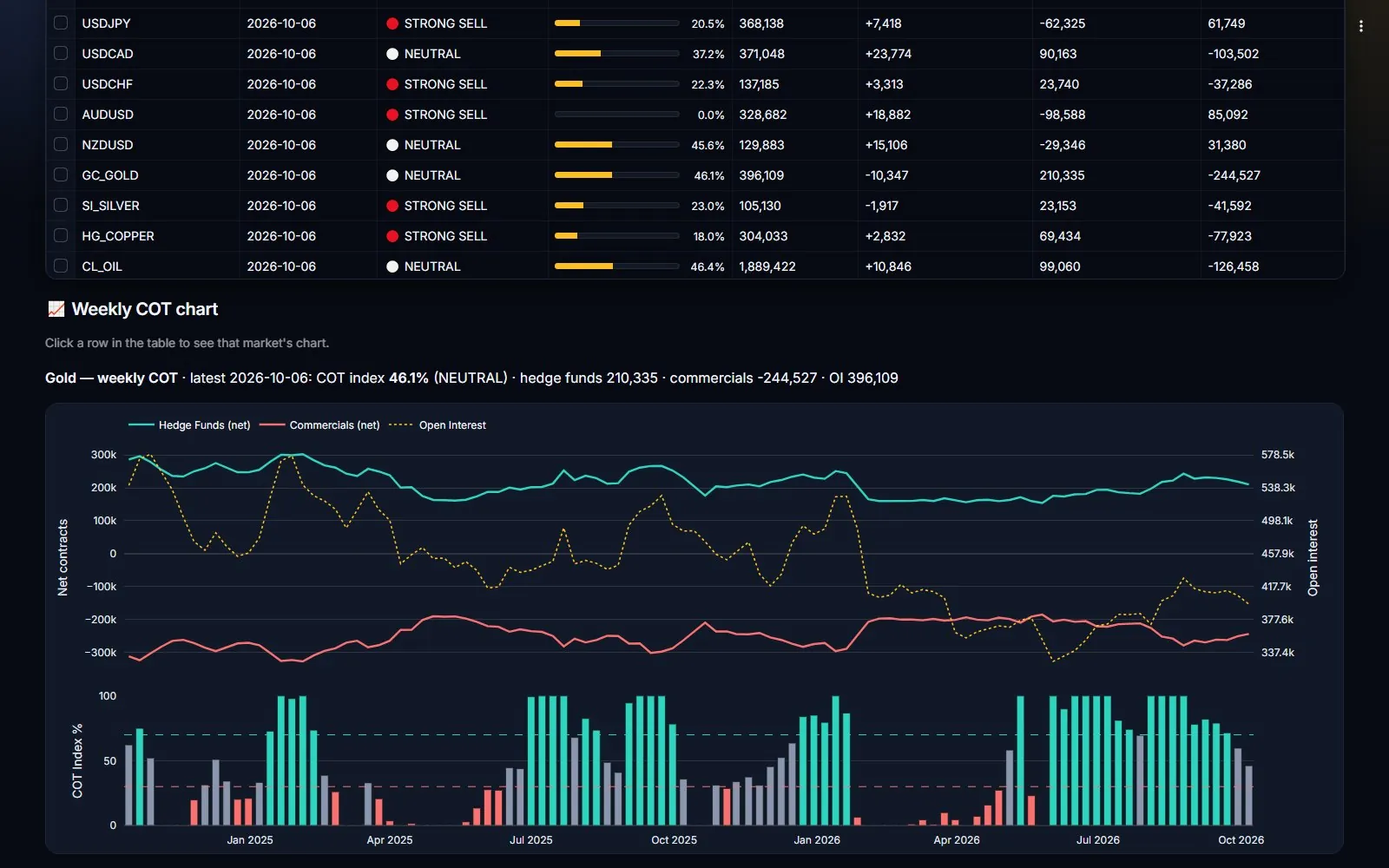
ICC Terminal handles this for you in the COT tab: pairs such as USDJPY, USDCAD and USDCHF are shown with the direction already converted to the pair. Still, when you read raw CFTC tables elsewhere, always check which way the contract is quoted before you read a signal.
Yen positioning and the carry trade
A carry trade means borrowing in a currency with a low interest rate and holding a currency with a higher rate to earn the difference. For many years the yen has been a popular funding currency, which is why large yen shorts are common when markets are calm. You can compare rates with the central bank interest rates page.
The risk is the unwind. If traders rush to close carry positions, they must buy back yen, and the yen can rise quickly. That is why a very crowded yen short deserves respect rather than blind trust: the position can be right for months and still reverse sharply when risk appetite changes or when the interest-rate gap narrows.
How to read it step by step
- Net position direction. Are speculators adding to yen shorts, reducing them or flipping to net long? Watch at least four to six weeks, not one report.
- COT index. The COT index places today's net position on a 0–100% scale against its own past range. You can calculate it yourself with the COT index calculator. Readings near the extremes show a crowded trade, not a guaranteed turn.
- Price versus positioning. If USDJPY rises while speculators cut yen shorts, something is out of line. Wait for price or positioning to give way.
- Open interest. Check the CME volume and open interest. Rising open interest with a trend suggests new money is joining it.
Common mistakes
- Reading yen longs as bullish for USDJPY. It is the opposite.
- Selling USDJPY only because the yen short looks crowded. Crowded trades can last a long time.
- Forgetting the data lag. The report is published on Friday for positions on the previous Tuesday.
- Ignoring central bank meetings and interest-rate news, which can reprice the yen in minutes.
How to use it with other ICC tools
A simple weekly routine: decide your bias from the COT tab, confirm with the currency strength meter (is the yen the weakest or strongest of the eight?), and then use your own chart analysis for the entry and stop. The forex COT guide shows how to compare several currencies together. Details of each screen are in the COT guide, and the latest numbers are on the COT report this week page.
Yen pairs are active in the Asian session. The free forex sessions and killzones tool shows the hours in your own time zone, and the pip value calculator helps because a pip on a yen pair is worth a different amount than on EURUSD.
Euro and other majors in one tab
ICC Terminal's COT tab covers EURUSD, USDJPY, the pound, Swiss franc and more, with COT index signals.
Get the COT report every Saturday on Telegram → t.me/icccharts
CFDs and futures carry a high risk of losing money. We may earn a commission if you open an account through this link.
FAQ
Is there a COT report for USDJPY spot?
No. The COT report covers regulated futures. The CME Japanese yen future is the closest public measure of large-trader yen positioning.
Does a yen net short mean USDJPY will rise?
It shows speculators expect a weaker yen, which is a bullish view on USDJPY, but it is not a prediction. A crowded short can also unwind quickly.
Which yen market does ICC Terminal track?
The CME Japanese yen future. In the COT tab it appears as USDJPY with the direction already converted to the pair.