
Managed Money vs Commercials: COT Report Categories Explained
Non-commercials, managed money, swap dealers, leveraged funds: the COT report uses many names for big traders. This guide explains who they are and which report to read.
Why the categories matter
The CFTC publishes the Commitments of Traders (COT) data in several formats. They use different names for the same big traders, and that confuses many beginners: one guide says "non-commercials", another says "managed money", a third says "leveraged funds". This guide explains what each name means, how the reports differ and which one to use. If you are new to the topic, start with how to read the COT report first.
The legacy report
The legacy report is the oldest and simplest. It splits every futures market into three groups:
- Commercials — traders who use the futures market to hedge a real business, such as a miner, a farmer, an oil producer or a bank managing currency risk.
- Non-commercials — large speculators such as hedge funds and trading firms, who take a view for profit.
- Non-reportable — small traders below the reporting limit.
Its strength is history: it goes back many years, so the COT index can compare today with a long range. Its weakness is that "non-commercial" is a wide group and it mixes different styles of speculator.
The disaggregated report
The disaggregated report covers physical markets such as metals, energy and agriculture. It splits the commercial side into finer groups:
- Producer / merchant / processor / user — the real hedgers of the physical commodity.
- Swap dealers — firms that take the other side of clients' trades, often for banks and index investors.
- Managed money — hedge funds, commodity trading advisers and similar professional fund managers. This is the group most traders mean when they say "speculators" in gold, silver, oil or copper.
- Other reportables — large traders who fit none of the groups above.
When you follow gold, crude oil or copper, the managed money line is usually the cleanest reading of fund sentiment.
Financial futures: the TFF report
Currencies, bonds and stock indexes are not physical commodities, so they have their own format, the Traders in Financial Futures (TFF) report. Its groups are dealers (banks that make markets), asset managers (pension and mutual funds), leveraged funds (hedge funds) and other reportables. Leveraged funds are the closest match to managed money in these markets. Our guides on forex and S&P 500 and Nasdaq positioning use this idea.
Which one should you use?
- Long history and a simple picture: the legacy report, with speculators against hedgers.
- Physical commodities and the fund view: the disaggregated report and its managed money line.
- Currencies, bonds and indexes: the TFF report and its leveraged funds and asset managers.
Do not mix the groups. A number from one report cannot be compared with a number from another, because the groups are defined differently. Pick one format for each market and stay with it so your COT index stays consistent.
How to read the groups
- Look at the net position of the speculative group (longs minus shorts), not only the longs.
- Compare it with the hedgers. They usually sit on the other side. See smart money vs hedgers for why a hedger's position is not a trading signal by itself.
- Put it on a scale. The COT index shows whether the position is near the top or bottom of its own range. You can test it yourself with the COT index calculator.
- Add open interest. Check whether the position is growing because new money is joining or only because others are leaving (open interest and price action).
Common mistakes
- Treating commercials as "smart money" that always wins. They hedge, they do not try to call the top.
- Comparing numbers from different report types.
- Using one week of data. Look at the change over several weeks.
- Forgetting the lag: the report is published on Friday for positions on the previous Tuesday.
How to use it with other ICC tools
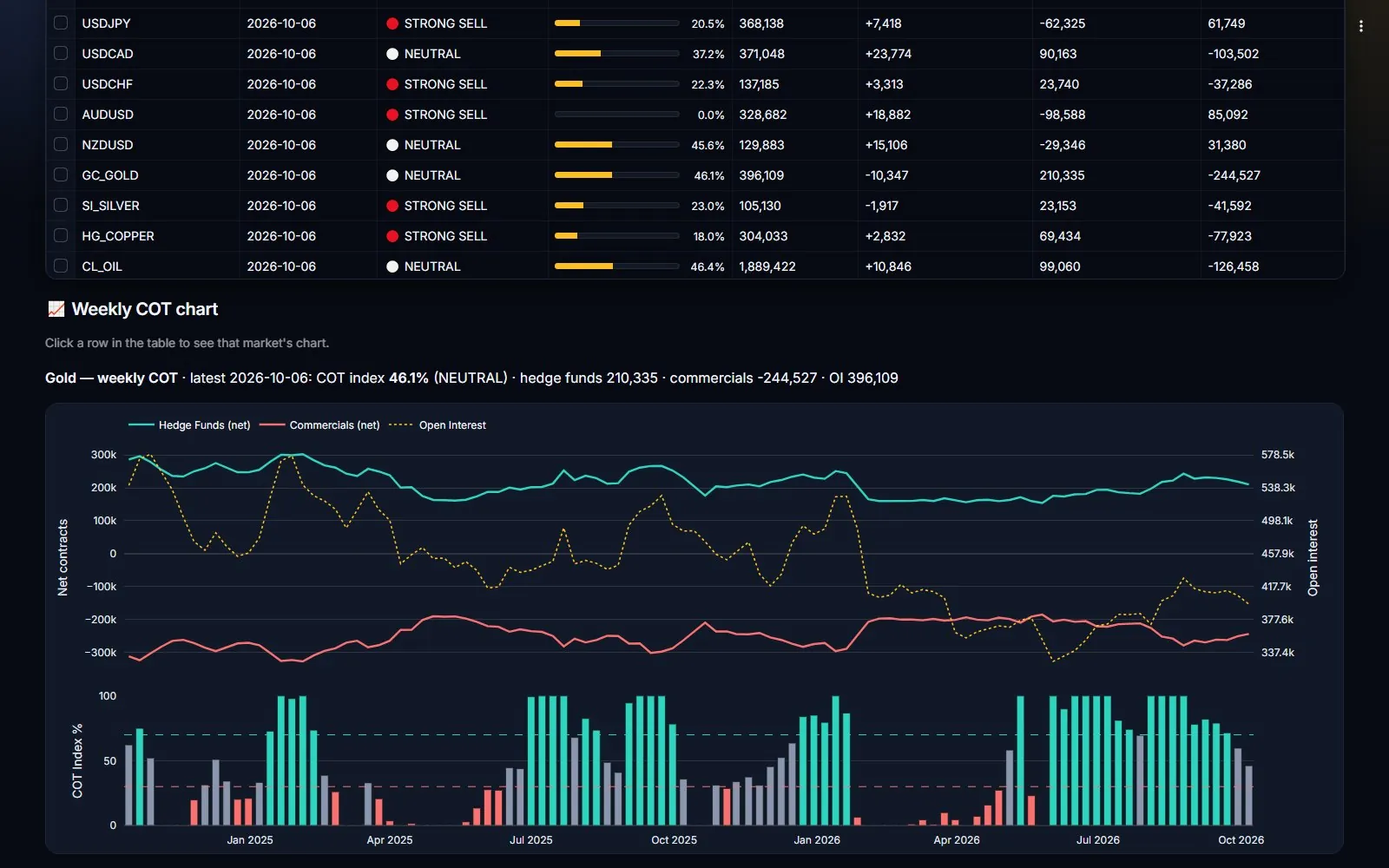
ICC Terminal's COT tab presents speculators against hedgers so you do not have to open the raw CFTC tables. Use it to set a weekly bias, then check the COT report this week page for the latest readings, and the COT glossary if a term is unfamiliar. Our free COT course walks through the same ideas in order.
Before you trade, size the position from your stop with the free lot size calculator and keep the risk small.
Euro and other majors in one tab
ICC Terminal's COT tab covers EURUSD, USDJPY, the pound, Swiss franc and more, with COT index signals.
Get the COT report every Saturday on Telegram → t.me/icccharts
CFDs and futures carry a high risk of losing money. We may earn a commission if you open an account through this link.
FAQ
What is the difference between non-commercial and managed money?
Non-commercial is the legacy report's wide speculator group. Managed money is a narrower group in the disaggregated report made of hedge funds and professional fund managers.
Do currencies have a managed money group?
No. Financial futures use the TFF report, where leveraged funds are the closest match to managed money.
Are commercials always right?
No. Commercials hedge real business risk and do not try to time the market, so their position is a context, not a signal.