
Australian Dollar COT Report: Reading AUDUSD Positioning
AUDUSD has no official position report of its own. The CME Australian dollar future is the closest public measure, and it points the same way as the pair. This guide shows what it covers, how the China and commodity link fits in, and how to read it carefully.
Why Australian dollar positioning matters
The Australian dollar, nicknamed the aussie, is often treated as a risk-sensitive currency. AUDUSD tends to react to global growth hopes, commodity prices, Reserve Bank of Australia decisions and US dollar moves. Spot forex has no central exchange, so nobody publishes the exact positions of all traders. What the CFTC does publish every week is the COT report, which includes the regulated CME Australian dollar futures. Reading it shows how large speculators and hedgers are positioned in the aussie.
It is a background filter, not an entry signal. Your own chart analysis decides when and where to act.
What the CME Australian dollar future measures
The CME contract is a future on the Australian dollar, priced in US dollars per Australian dollar. It trades side by side with the spot market. In the COT report the groups that matter most are:
- Speculators (non-commercials) — hedge funds and large trading firms with a market view. Their net position (longs minus shorts) is the main sentiment reading.
- Hedgers (commercials) — banks and companies managing currency risk from real business, such as exporters. They often sit on the other side of the speculators.
See smart money vs hedgers and managed money vs commercials for the difference between report types.
No inversion: Aussie futures follow AUDUSD
AUDUSD is quoted as US dollars per Australian dollar, and so is the CME future. That means:
- Speculators adding aussie longs = a bullish view on AUDUSD.
- Speculators holding a large aussie net short = a bearish view on AUDUSD.
The same rule applies to the pound and euro (see the pound guide and euro guide). Pairs that start with the dollar, such as USDJPY and USDCAD, need to be inverted (see the Canadian dollar guide).
The China and commodity link
Australia exports large amounts of metals and other raw materials, and China is a major buyer. Because of this, the aussie is often seen as a way to express a view on Chinese demand and global growth. Two things are worth checking next to the AUD reading:
- Metals positioning. Compare with the copper COT guide and the gold COT guide. When copper and the aussie both show rising speculative longs, the growth story is consistent.
- Risk mood. The aussie often rises when markets feel confident and falls when they get nervous. The S&P 500 and Nasdaq COT guide shows how stock-index positioning looks at the same time.
These links are tendencies, not rules. Interest rates and the US dollar can overpower them for weeks.
How to read it step by step
- Net position and its direction. Is the speculator net position growing, shrinking or flipping sign? Look at four to six weeks, never a single report.
- COT index. The COT index places the current net position on a 0–100% scale against its own range. Calculate it with the COT index calculator. A reading near an extreme shows a crowded trade, not a guaranteed turn.
- Compare with price. If AUDUSD makes new highs while speculators cut longs, positioning and price disagree. Wait for one of them to give way.
- Open interest. Rising open interest in a trend suggests new money; falling suggests closing. See open interest and price action.
Common mistakes
- Treating a crowded long or short as a reason to trade against the trend right away. Crowded positions can last for months.
- Using the report as a timing tool. The data is from Tuesday and arrives on Friday (see release time and data lag).
- Ignoring rate differences. Compare the Reserve Bank of Australia and the Federal Reserve on the central bank interest rates page.
- Skipping position sizing. Use the lot size calculator so one trade cannot hurt your account more than you planned.
How to use it with other ICC tools
A simple weekly routine: set your bias from the COT tab, confirm it with the currency strength meter, then use your own chart for the entry and stop. The forex COT guide shows how to compare several currencies at once. Details of each screen are in the COT guide, and the newest numbers are on the COT report this week page.
The aussie is most active in the Asian session. The free forex sessions and killzones tool shows those hours in your own time zone.
FundedNext Partner link We may earn a commission if you buy through it. Prop firm challenges are paid evaluations; most traders don't pass. Trade only what you can afford to lose.
Aussie, loonie and pound in one tab
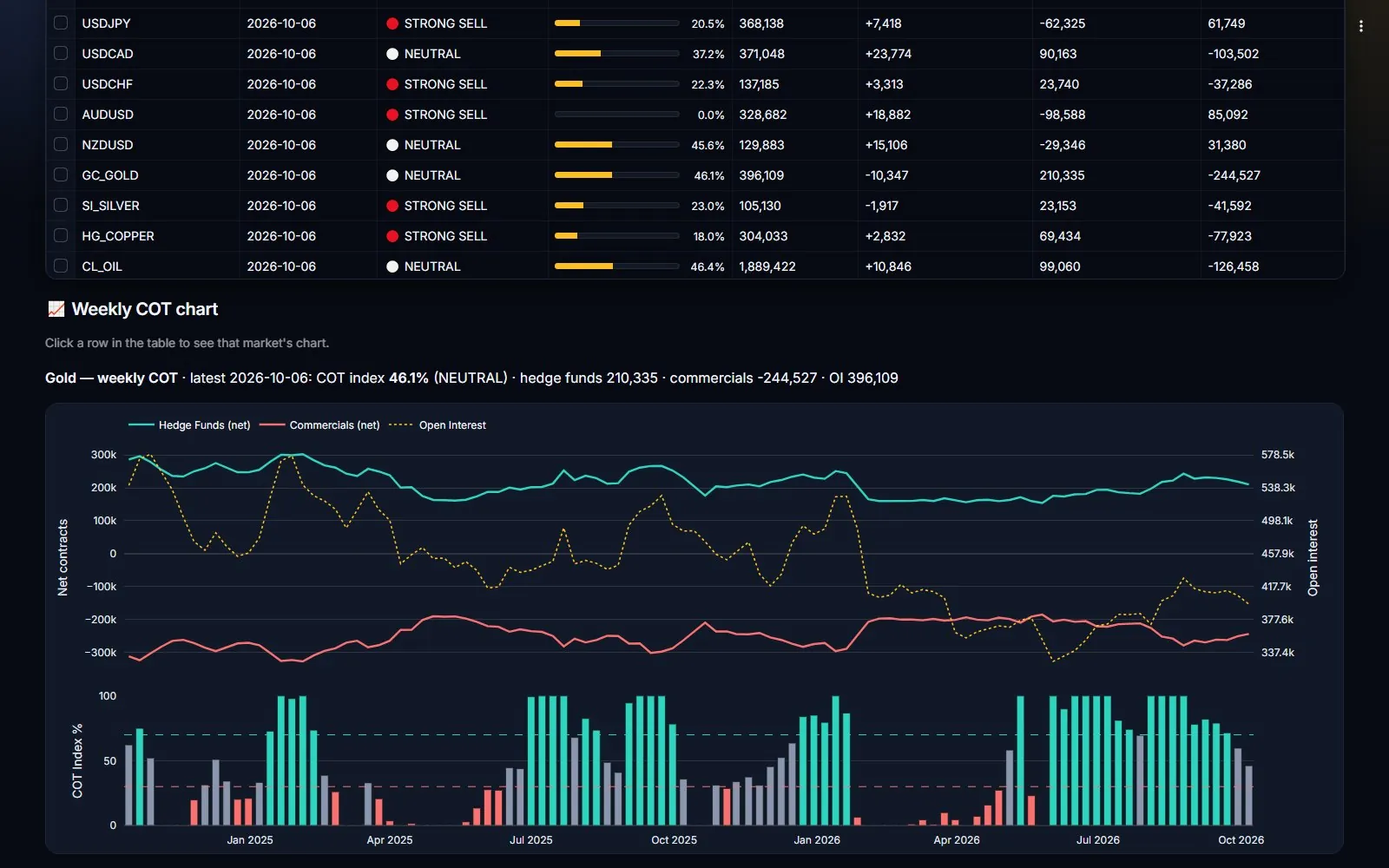
ICC Terminal's COT tab covers AUDUSD, USDCAD, GBPUSD and more, with COT index signals.
Get the COT report every Saturday on Telegram → t.me/icccharts
CFDs and futures carry a high risk of losing money. We may earn a commission if you open an account through this link.
FAQ
Is there a COT report for AUDUSD spot?
No. The COT report covers regulated futures. The CME Australian dollar future is the closest public measure of large-trader positioning in the aussie.
Does an Australian dollar net long mean AUDUSD will rise?
It shows speculators expect a stronger aussie, which is a bullish view on AUDUSD, but it is not a prediction. A crowded long can also unwind quickly.
Do I need to invert the Australian dollar COT data?
No. The CME future is quoted in US dollars per Australian dollar, like AUDUSD, so the direction is the same.